
Gaining occupational therapy experience in Sri Lanka
Updated: 5 days ago
Alanna Stobbe, an occupational therapy student at UBC, spent two months completing an elective in Sri Lanka.
"In February and March of 2025, I had the opportunity to complete one of my Level 3 (senior-level) placements in Sri Lanka as a second-year Master of Occupational Therapy student at the University of British Columbia. Supported by the Global Health Trainee Grant, I worked at Navajeevana Rehabilitation Centre and its affiliated Special Schools in the Southern Province region, which serve children with varying developmental and learning needs. My role focused on collaborative learning, cross-cultural engagement, and co-developing sustainable therapeutic practices in partnership with local professionals and families.

From the outset, I was struck by the deeply communal nature of care within these schools. Teachers played a central role in leading classes and facilitating the school day, creating structured learning environments while also accommodating the diverse needs of the children. Parents accompanied their children daily, providing one-on-one support during meals, assisting with behaviour regulation, and helping with transitions. When not actively supporting their child, many contributed to school maintenance or gardening, while also forming strong networks of mutual care with other families. This collaborative model of caregiving extended support beyond the child, fostering peer-to-peer relationships and a sense of shared resilience.
As a team of four UBC MOT students, we approached our work with cultural humility, collaborating closely with a Sri Lankan field officer fluent in both Sinhala and English. Their guidance was instrumental in helping us navigate cultural nuances and shape recommendations that were appropriate, respectful, and feasible. In every interaction, we emphasized transparency, consent, and choice—positioning ourselves not as experts but as collaborators. We were intentional in all our actions, guided by a central goal: to ensure sustainability beyond our time there.
Living in the same town where we worked for seven weeks allowed us to form meaningful connections within the broader community. We embraced local cultural practices, remained open to learning, and developed lasting friendships with local staff members and residents. Motivated by curiosity and respect, we made an effort to learn and practice Sinhala throughout our stay: acquiring basic greetings, simple vocabulary, and key occupational therapy-related terms to support daily communication and build rapport. This immersion enhanced our cultural understanding, facilitated more inclusive interactions, and fostered a genuine sense of belonging. On our days off, we took the opportunity to explore the Southern Province, visiting nearby towns and appreciating the beauty and diversity of the region. These experiences outside of placement enriched our time in Sri Lanka, deepening our appreciation for the communities we were privileged to learn from.

One of the most significant lessons I learned was that rehabilitation priorities are culturally shaped. We came to understand that the focus of care is often not solely on individual independence, but rather on collective well-being and the preservation of family and societal roles. This understanding shifted my clinical reasoning. Rather than prioritizing independence in isolation, I began to ask questions about how tasks could be performed meaningfully within a given context, aligning with cultural values and caregiving structures. This reframing deepened my appreciation for culturally responsive practice and reinforced the importance of adaptability in international work.
A key contribution of our team was the co-creation of low-cost adaptive tools—such as dressing aids, sensory regulation items, and seating modifications—using locally available materials. We worked in collaboration with workshop staff at the centre to design, test, and refine prototypes based on direct observation and feedback from families and teachers. The creation process was intentionally hands-on and inclusive, with staff fully involved from start to finish. We aimed to make it a purposeful and enjoyable experience, fostering shared learning and a sense of ownership. Throughout, we welcomed feedback to ensure the tools were functional and appropriate. We also made certain that staff understood both the “how” and the “why” behind each design, reinforcing the sustainability and potential for ongoing innovation beyond our placement. Examples of the adaptive tools we developed included built-up grips for writing, a button hook, a weighted blanket for calming sensory input, custom shoe modifications to support ambulation, specialized walking aids, and dressing sticks. These tools were not only practical but also reflected the adaptability and creativity of the staff and families involved in the process.
In addition to the adaptive tools, our team was involved in a variety of other initiatives. We educated both parents and teachers on sensory processing and the importance of understanding sensory profiles. We provided visual aids for toileting and developed emotion regulation tools to help children manage sensory overload and emotional challenges. We also collaborated with a teacher to create a social story designed to educate a child on appropriate personal boundaries and reinforce the importance of body safety. To support focus, self-regulation, and communication in the classroom, we created communication boards and sensory toys such as sand/rice-filled balloons and a sensory sandbox. To address fine motor challenges, we introduced graded activities such as button and hair braiding practice as a means of developing coordination.
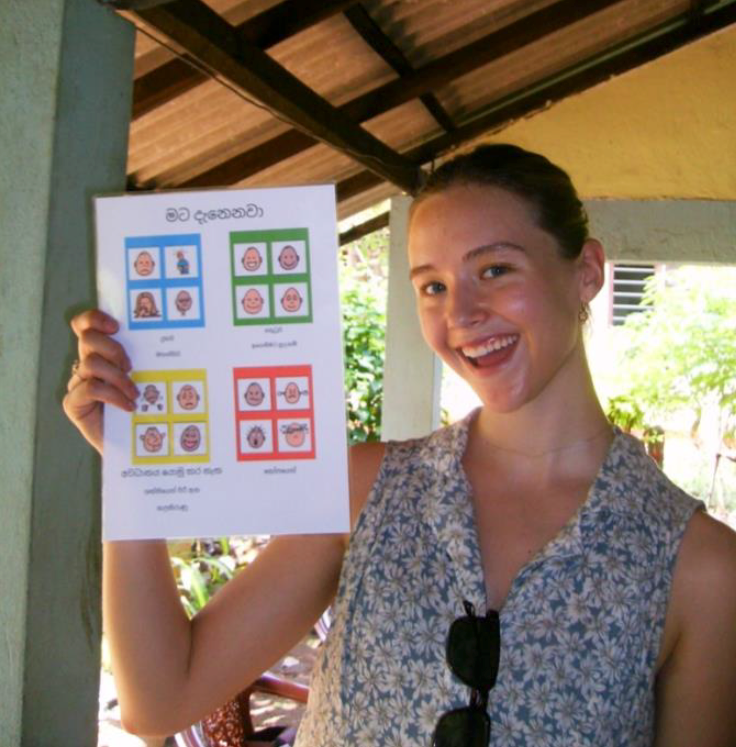
We provided one-on-one consultations with teachers, recommending seating modifications and strategies such as movement breaks, muscle activation exercises, and play therapy to support children’s physical and emotional development. In addition, we worked with parents to educate them on positioning techniques, wound management, and ergonomics while transferring children. We also recommended ambulation aids and referred families to the Navajeevana physiotherapy team for further assessment and support.
This experience has been transformative, both personally and professionally. I have honed my ability to communicate with greater clarity and impact by using purposeful language, incorporating visual aids, and leveraging translation tools to promote understanding across diverse audiences. I also came to deeply value the importance of regular team reflections and collaborative check-ins with local staff to ensure our efforts remained culturally respectful and contextually relevant. I am grateful for this opportunity, which has not only deepened my appreciation for global partnerships but also reaffirmed my commitment to providing care that is sustainable, culturally responsive, and grounded in community. The insights I have gained will continue to shape and inform my future practice as an occupational therapist."


Comments